
I went to a workshop day on the materiality of the far right a couple of weeks ago and in discussing our various projects, the topic of the importance of foreign-language resources was briefly touched upon.
As someone whose own scholarship can be broadly located in Global Language-based Area Studies–my PhD pathway required an element of foreign-language research, for example–that strikes me as a given. But you know how it is, you’re looking for something, and it appears that not many people have written about said thing, and that gets you thinking that perhaps your idea is a bit more novel than you initially thought as seemingly no-one else on the planet has thought or written about it, and so on and so forth. More than anything, it exposes our overreliance on English as a lingua franca when it comes to academic scholarship, particularly if you live and work in a predominantly English-speaking country.
In some respects, that is not unexpected, particularly as–in the UK at least–the teaching of foreign languages in secondary schools have been on a disastrous decline for a long time, with particular implications for pupils from less affluent socio-economic backgrounds in the long run. I for one could not have gone on my Auslandsjahr to Regensburg without support from the ERASMUS scheme, now sadly defunct in the UK following Brexit. Subsequently, many universities in the UK are facing cuts to their MFL departments, if they haven’t been ditched altogether by now. With all of this in mind, you might even get the impression that accessing resources in their original language doesn’t matter at all if your own university treats its language learners so poorly.
When it comes to studying the global resurgence of the far right, an understanding of the socio-political and cultural contexts from which its various facets have emerged is vital. That is a truism that bears repeating as, in some cases, it will involve a consideration of language on two fronts. The first concerns research participants and the language they use to form understandings about their activism and the life experiences which have led to their far-right support. The second concerns academics, researchers, and journalists who have followed and written about a particular group or party in a given language. These considerations can be both practical and theoretical in nature.
In the methodology chapter of my book, I talk about women’s use of certain words, for example, using Klimahysterie to describe climate change. That tells me a couple of important things right off the bat. Firstly, that person appears to engage in conspiratorial thinking e.g., that climate change is a hoax or that the global response to it is over the top, or even hysterical, as the term implies. Secondly, given that the AfD has engaged in climate change denial, including platforming prominent German climate change deniers such as Naomi Seibt, I get a sense of where they stand on it politically. There is something to be said about cultural competence, e.g., the idea that while non-native language speakers may ‘succeed’ in talking with research participants in their own language, that does not necessarily mean they understand them (slang, loaded words, metaphors, etc.). Coming in as an ‘outsider’ has its own set of challenges, but I found that there is a process of give and take when it came to building trust and rapport with the women I spoke with. The majority of the women I spoke with could speak English to a passable degree but they mostly chose to speak in German so that they could sufficiently get their ideas across; sometimes translating something into English makes it lose its implicit meaning in German. Additionally, I’ve written elsewhere that there is a tension between the accurate reporting of women’s accounts and their broader empirical claims and this comes back to a central issue of power: who gets to say what, to whom, and to what end? It’s our job to critically engage with these broader empirical claims though this does not necessarily mean that we should be ‘fact checking’ women’s self-reports about their childhood or personal experiences.
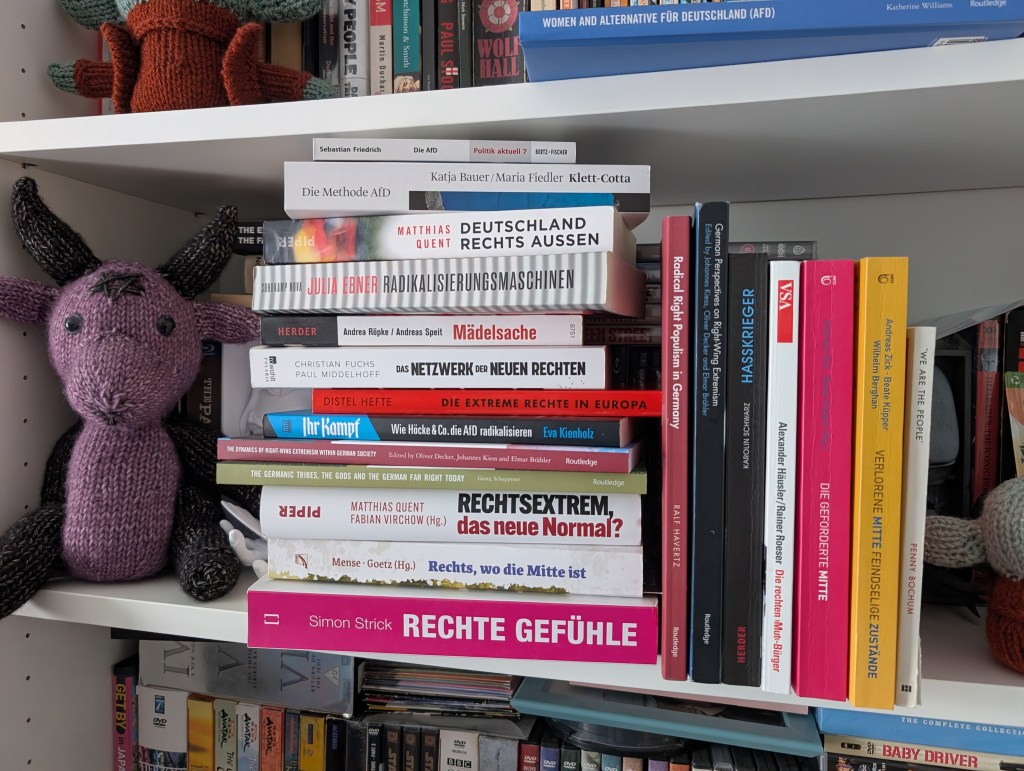
Alongside this empirical work, I utilised many German-language resources which have offered an deeper perspective on the rise (and seemingly unabated rise) of the AfD. This has been invaluable in terms of commentary on local AfD figures, the success of the AfD across the 16 German states, the legacies of reunification and how these intersect with AfD activism in the former GDR states, empirical studies measuring broader social attitudes (e.g., the Mitte Studie), the links between the AfD and local and national far-right organisations/groups, and on-the-ground federal and state election analysis. This has also involved reading the semi-autobiographical monographs of various AfD figures of past and present, e.g., Alice Weidel, Bernd Lucke, and Björn Höcke, as well as party materials. Taking the interview accounts and German-language sources together, then, I was able to ‘thicken’ my analysis and really get into the specificities of what women, the AfD, and German academic and media commentators were saying about a given topic at a particular moment in time.
As I reflect in the book, learning any language is an imperfect process, but an understanding of both language and culture is essential if we’re to traverse the rocky epistemological terrain of why people support the far right in a given context.

